
Restaurant Bookkeeping Basics for Daily Sales Tips and Food Costs
A restaurant owner closes at 11 PM, counts the cash drawer, glances at the POS total, and goes home. The numbers looked fine. Sales were strong. But nobody reconciled the cash to the report. Nobody checked whether the tips were recorded correctly. Nobody looked at what the kitchen spent on food that day versus what it sold. By the time someone does look, it is three weeks later, and the details are gone.
Restaurant bookkeeping moves faster than most industries because the business moves faster. You handle cash every day. Tips flow through every shift. Inventory walks out the door as meals. If your bookkeeping routine does not match the pace of your restaurant, problems stay hidden until they show up on a monthly P&L that is already too late to fix.
This post walks through a simple daily and weekly bookkeeping routine for restaurants, explains how to track tips and food costs correctly, and shows you the one metric that tells you more about your margins than anything else on your financial statements.
The Daily Routine That Keeps Your Numbers Clean
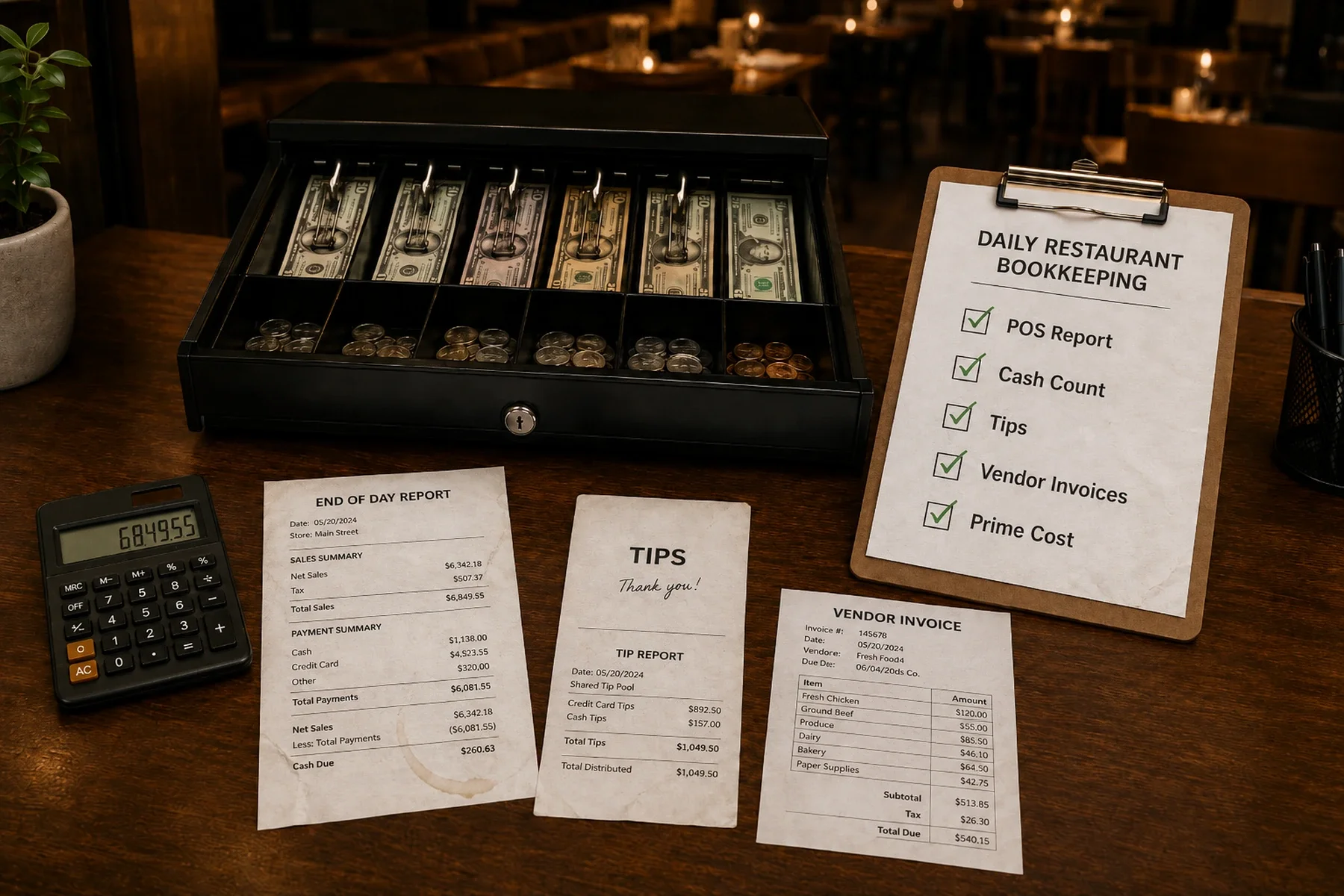
Restaurant bookkeeping starts at the end of every shift, not at the end of the month. The daily routine is simple, but it has to happen consistently, or the numbers drift.
Start with your POS report. Every modern point-of-sale system generates an end-of-day summary showing total sales by category (food, beverage, retail), payment methods (cash, credit, gift cards), discounts, voids, and comps. That report is the starting point for everything else. Print it or save it digitally every single day.
Next, reconcile the cash. Count what is in the drawer and compare it to what the POS says should be there. If the POS shows $482 in cash sales and the drawer has $475, you are $7 short. Record that difference every day. Small cash variances happen. But when those variances trend in one direction over weeks, you have a problem worth investigating. A daily cash over/short log is one of the simplest and most valuable controls a restaurant can run.
Finally, record any invoices that came in during the day. Food deliveries, beverage orders, cleaning supplies, and equipment repairs. If a vendor dropped something off and left a bill, that bill needs to be logged the same day. When invoices pile up for a week before anyone enters them, your expense tracking falls behind your actual spending. That gap makes every financial report less accurate until someone catches up.
This daily routine takes about fifteen minutes. Skipping it for a week creates hours of reconstruction work later.
Getting Tips Right on the Books
Tip reporting is one of the areas where restaurant bookkeeping gets more complicated than other small businesses. Tips flow through your restaurant in several forms: cash tips left on the table, credit card tips added to receipts, and tip pools or tip-outs shared among staff. Each one has to be tracked, reported, and handled correctly for both tax and payroll purposes.
Credit card tips are the easier side. They show up on your POS report and get paid out through payroll. The IRS expects those to be reported as income for the employee who earned them. Your payroll system should handle the withholding automatically as long as the tips are recorded correctly in the POS.
Cash tips are harder to track because they leave the building with the employee at the end of the shift. Employees are legally required to report their cash tips, and you are required to include those reported amounts in their payroll for tax purposes. Most restaurants use a tip reporting form that employees fill out at the end of each shift. If your staff is not reporting cash tips consistently, your payroll taxes and your employees' tax returns are both going to be wrong.
Tip pools and tip-outs add another layer. When tips get redistributed among servers, bussers, bartenders, and kitchen staff, the bookkeeping needs to track who received what. This matters for payroll, for tax reporting, and for compliance with your state's tip distribution rules. A clean tip tracking system prevents confusion, wage disputes, and IRS problems.
Why Prime Cost Is the Number That Matters Most
Every restaurant owner looks at revenue. Most look at food cost. The number that actually tells you whether your restaurant is healthy is prime cost, and most owners do not track it closely enough.
Prime cost is your total food and beverage cost plus your total labor cost (including taxes and benefits). It typically represents 55% to 65% of a restaurant's total revenue. When prime cost creeps above that range, your margins are shrinking even if sales look strong. When it stays below, you are running a tight operation.
Tracking food cost alone misses half the picture. A restaurant might run a 28% food cost, which looks great on paper. But if labor is at 38%, prime cost is 66%, and the restaurant is losing money despite healthy food margins. The two numbers have to be viewed together because they push and pull against each other. Cutting kitchen staff to save on labor, and food waste goes up because fewer people are managing prep. Adding staff to improve quality, and labor cost rises. Prime cost shows you the combined effect.
The practical habit is simple. Every week, compare your total food and beverage purchases to your total sales for the same period. That gives you a weekly food cost percentage. Then look at your labor cost for the same week from your payroll records. Add them together. If that combined number is consistently above 65% of revenue, something needs attention. Either food costs are running high, labor is not matching sales volume, or both.
Weekly tracking catches problems while they are still small. A monthly P&L tells you what happened last month. A weekly prime cost check tells you what is happening right now.
Build the Routine Before the Month Closes
Restaurant bookkeeping works best when it matches the rhythm of the business. Daily cash reconciliation, daily POS reports, and daily invoice entry keep the numbers current. Weekly prime cost tracking keeps your margins visible. When those habits are in place, your monthly financial statements actually reflect reality instead of forcing your bookkeeper to reconstruct weeks of missing data.
The restaurants that stay profitable in a tight-margin industry are rarely the ones with the fanciest accounting software. They are the ones with consistent daily habits and an owner who looks at the numbers every week, not just when something feels wrong.
If your restaurant's bookkeeping is always playing catch-up, or if you are not sure your tips, cash, and food costs are being tracked correctly, we can help you set up a routine that works. Book a free consultation, and we will walk through your current setup together.
